
 |
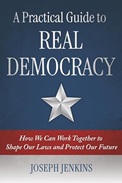
Jenkins' book explores what real democracy looks like. It isn't just decision-making power every four years, but every day, on every major issue. American citizens, not billionaires or huge corporations, are the ones who decide. Real democracy follows four guiding principles. Governments exist to serve the people. Citizens vote directly on laws and actively participate in lawmaking. Lastly, public servants are randomly selected, not elected. In intelligent selection, anyone who wishes to serve as a public representative can opt in voluntarily via a platform such as their tax return. Random selection from this pool, a rigorous test of their understanding of governance, and another random selection determine the representatives and alternates. Past examples, ranging from milking a cash cow to a scamdemic, underscore why democracy's evolution matters for the world of tomorrow.
Practically speaking, the author's guide pulls the world of tomorrow into action steps for today. The ideas presented here are not abstract or so conceptual that it's tough to figure out how to put theory into practice in daily life in America. Instead, the author's action steps flow naturally from a systematic, organized approach to real democracy, giving people a true voice in deciding on issues. Real democracy's principles double as the guide's action steps, outlining clear ways people can get involved and stay involved. Exploring examples like the COVID pandemic reveals deep discussion points about the web of relationships behind closed doors and even in news articles. Considering real democracy, almost like the mirror universe or alternate realities in Star Trek, bubbles a few topics up to the surface as food for thought, including what "We the People" really means, how it's applied, and how it could improve.