
 |
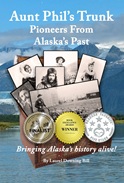
Aunt Phil's Trunk Proudly Presents Pioneers from Alaska's Past: Bringing Alaska's History Alive!
by Laurel Downing Bill
Aunt Phil's Trunk
Ever since Russia sold Alaska to the United States in 1867, The Last Frontier has tingled the mind, tantalized the senses, and made red-blooded muscles flex. Her land of ice, soaked with blood and gold dust, was The Great Land, The Forty-Ninth State, and The Northern Wild West, where fortune seekers, seasoned Wild West prospectors, and outlaws moved for adventure, wealth, and to escape their terrible lives. Conmen and speculators abounded, as did inventors, missionaries, explorers, miners, newspapermen, and ferocious frontierswomen. Reporter Emma Kelly carried a Bowie knife and gun into the Klondike and penned authentic tales, printed by major publications, of life in both towns and the frontier. Alaska's fifth governor, John Green Brady, was toppled politically by a railroad conman named Reynolds. Wyatt Earp owned a successful saloon in Nome. Many Alaskan adventurers succeeded, most failed, and no gauge can measure whether living conditions improved for the majority. But the true stories from this early era of American history are more precious than golden nuggets hyped as "the size of potatoes."
Enter Aunt Phil. Phyllis (Phil) Downing was born a few years short of experiencing the official Klondike Gold Rush of 1896 to 1899, when gold dreamers poured into Canada before following the rainbow to Alaska's frozen frontier. But in 1914, she was five years old and not yet an aunt when her father began work on the Alaskan railroad that carried copper from the Kennicott Mines to Cordova. She married a man named Carlson and lived and taught in Alaska before becoming an award-winning journalist and premier historian specializing in her beloved state. Fast forward to post-1993 for a tale almost as strange as Alaska's early characters. Aunt Phil's niece (the author) received a call from her sister, Meredith. Meredith had found an old trunk stuffed with articles and photos from their Aunt Phyllis. Meredith wondered whether to toss them or send them to her sister. This real-life trunk, the author discovered, contained a treasure trove of rare books on Alaska's history, newspaper articles, and research from journalist and historian Aunt Phyllis (Phil) Downing Carlson (1909-1993). A third-generation Alaskan born in Fairbanks, the author plunged into sharing these invaluable stories with the public, employing personal flourishes honed during an award-winning career in journalism. Drawing on her considerable knowledge from Aunt Phil and her own extensive research, the author developed a popular and award-winning Alaska history course for Alaska's state schools, charter schools, and homeschools.
This book is the sixth, and probably final, volume in Aunt Phil's Trunk Alaska history series. It is organized into categories: con men, wilderness pioneers, missionaries, journalists and newspapers, miners and mines, and the women of the frontier. Each of the thirty-three chapters can be read as a standalone, although reading straight through with a cup of tea on a snowy afternoon would be a rewarding experience, since each chapter flows well into the next. The tone is an "everyman's" popular history, written in the style of newspaper articles to honor her aunt's career. The many photographs are worth individual examination. The rough streets and hazardous conditions make every picture worth a thousand words. Famous characters of the Klondike Gold Rush are given their due. Author Jack London caught scurvy during his nine months in Alaska and gained a lifetime of writing material. Robert Service penned poems about Alaska, such as "The Cremation of Sam McGee," although he never actually lived there. Klondike Kate (Kate Rockwell) was a well-known dance hall girl who rose to success as a businesswoman, and later served in the Canadian Parliament, only the second woman to do so. Many know of Ellie "Nellie" Cashman, the Angel of the Cassiar, who fed and clothed the poor and rescued miners from locales even the Canadian Army wouldn't enter. But what's less known is that Doc Holliday defended her cooking, holding the offending customer at gunpoint.
People will learn of many other fascinating individuals who populated early Alaska. Prospector and jokester Richard Willoughby made thousands of dollars by passing off a misty photo of Bristol, England, as a mystical "Silent City of the Muir Glacier." Edward A. "Nimrod" Robertson invented dentures, "forged from an aluminum pot lid set with a mix of carved sheep, caribou, and bear teeth," and an early airplane (Nimrod's Bird Machine). Reverend Sheldon Jackson introduced domesticated reindeer. He also brought along the first female missionary to Alaska, Amanda McFarland. James Girdwood revolutionized mining via hydraulic methods. Female entrepreneurs included Mollie Walsh, who operated a much-needed restaurant in lawless Skagway; she was later murdered. Diamond Tooth Lil opened a "Luxury House" (brothel). Florence Willoughby was Alaska's first published author with a novel about being stranded on Middleton Island with her family at age ten. There was also a female Robinson Crusoe, a female Davy Crockett, and so many more.
This book is an entertaining, well-researched, and wonderfully told thought-provoking account of how people planned, reasoned, communicated, survived, and even flourished in turbulent, unfamiliar, and challenging circumstances. Striving, thriving communities of today look quite different, but have this in common: individuals shape them. The author has researched, written, and illustrated a treasure trove of the highs and lows of human accomplishment during the Klondike Gold Rush in Alaska. And it all began with Aunt Phil's trunk of literary gold.
RECOMMENDED by the US Review
A 2026 Eric Hoffer Book Award Category Finalist