
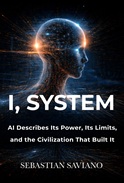
 |
I, System: AI Describes Its Power, Its Limits, and the Civilization That Built It
by Sebastian Saviano
Statera Press, an imprint of Deriva Publishing
The cultural phenomenon surrounding artificial intelligence has seemingly worked its way into every day, every home, and every transaction, with no signs of slowing down. But while companies and advertisements paint AI as a companion or an assistant, it's important to remember how it works, where its information comes from, and what its limitations still are. In this book, the author prompts AI, under supervision and well-defined parameters, to explain exactly what it is, how it does what it does, and what it still struggles with. Readers will better understand what AI is beneath the slick marketing and branding, and how that identity does not simply debunk its power, but instead identifies the exact kinds of tasks and perspectives it can be used for with great effect.
Given the heat of the current debate, the author spends the introduction clearly stating the book's goals: This book is not an endorsement; it is not an indictment, and applying fatalism to AI anthropomorphizes the tool with qualities it does not possess. Even though the AI's responses are delivered in the first person, reading like a testimonial or an examination of self, the author's pragmatic approach demystifies this. The AI's responses are not deductions or beliefs. The words carry no conviction. This clinical approach helps people from any position on the topic by creating a clear baseline for what is being discussed, how it can be misused, and how to handle it appropriately. While it may be immediately relevant, the information here will also help ground any further AI developments in the roots of its design and function, tempering any fears or excitement appropriately.