
 |
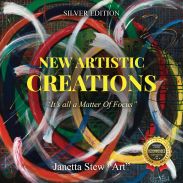
This art book focuses on the colorful, abstract illustrations of Garry Stewart. It features the work he created during the last decade of his life, 1989 through 1999. His sister is the caretaker of his work and has created this full-color book, combining his art with scriptural verses addressing similar topics and themes. This collaboration shows the influence of two important impacts on Stewart as he turned to art for expression: an upbringing grounded in faith and an emphasis on creativity.
Stewart's creations display the marks of varied interests, from bold, colorful geometric patterns to African folk influences and abstract expressionism. His sister's scriptural pairings display a reader well-versed in the Bible and attuned to Stewart's vision and motivation. The author opens the book with a prize-winning illustration, The Sacred Heart, which her brother made when he was only eleven. This is hauntingly reflected in a similar piece, Love and Peace, created during the last years of his life, encapsulating his life in a full circle.
Whether directly or indirectly, there are many painters clearly represented in Stewart's work, from the jazz-inspired works of Wassily Kandinsky, Edward Davis, and Aaron Davis, to Jackson Pollock and Pablo Picasso. A few of Stewart's works, on which these similarities are on display, include State of Beauty, Red Corvette, and Back Wall. The addition of hand-picked biblical verses by the author parallels the religious works and calendars of Thomas Kinkade.
Readers who find the correlation between art and religion fascinating may want to explore Russ Ramsey's Rembrandt in the Wind: Learning to Love Art through the Eyes of Faith. In his work, he examines the art of famous artists through detailed discussions, analyzing their work in relation to the influence of religion and the human experience of coming to terms with God. Ramsey's work differs from this book as Stew Art doesn't offer a narrative or informational text along with the art. Rather, her biblical verse pairings are meant to stand on their own and allow the reader to draw their own conclusions between the verses and her brother's artwork.
Other than a brief introduction and closing acknowledgement, this work doesn't contain the author's original written composition. Instead, it is a collection of verses paired with her brother's work. The author's selection of verses is interesting, though. For example, there are many cases where the included verse highlights the subject of the artwork and allows the reader to consider the image in a different light and tone. However, there are occasions where the paired verse does not seem to reflect the artwork and feels a little forced. When looked at in its historical context, the book does a great job at showing how the influences of early painters were reflected in the styles of the 1990s art world. That influence has continued to contribute to new artists, as seen in some current artists like Basquiat. Readers interested in art, including but not limited to those of the Christian influence, will likely find this work entertaining to explore.