
 |
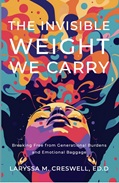
The Invisible Weight We Carry: Breaking Free From Generational Burdens and Emotional Baggage
by Laryssa M. Creswell
Illumify Media
In this journey, Creswell effectively helps readers understand themselves and take the reins of their own lives, come what may. Seeing herself as a guide in this process, the author provides vital tools to tackle challenges like generational and childhood trauma. The metaphor of carrying a small backpack that continues to fill with invisible weight that unknowingly is bogging you down resonates seamlessly and is a pertinent part of the self-awareness process. In fact, this weight even gets glamorized as a demonstration of one's strength and ability to push through. However, Creswell succinctly provides the tools to first identify and name this weight. In essence, the author dives into both the therapeutic and scientific aspects of the invisible weight to convey that this trauma fundamentally reshapes our brain and nervous system.
The author's ability to break down complex psychological concepts, such as the amygdala, using the analogy of a phone alarm system, provides clear visual cues that even laypeople can piece together. Ultimately, Creswell aims for her clients to rebuild their resilience and mitigate the brain's conditioned response to stress and trauma. Interestingly, she digs even deeper and demonstrates that all trauma gets stored in the body. Often, it is the fight-or-flight concept that impels individuals to simply push past it or store it away in a forgotten corner while they attend to more pressing matters. What these individuals do not realize, however, is that the trauma is simmering beneath the surface, and when it does rise to the forefront, it has an unimaginable shattering effect.
Creswell's delivery in this work is multidimensional, budding from years of experience in her own clinic. Shifting from theoretical knowledge to practical experience, she helps readers with introspective breathwork that establishes a stronger, innate connection with the body, mind, and spirit. While this alone does not heal one from trauma, it does aid in our emotional response when that traumatic memory creeps to the surface. Further, Creswell breaks down familiar terms like "burden," especially in the context of one's role, to guide readers in managing their responsibilities and learning to delegate effectively by asking the tough, honest questions.
At its core, the author's work is interactive, with Creswell's timely exercises geared toward unveiling the individual's story and helping readers become comfortable putting themselves first. It is instrumental in both absolving the reader from the burden of responsibilities as well as freeing them from the guilt of "honoring your own needs." With the level of burnout at record levels globally and expectations spiking, whether they are internal, societal, or family-based, a work like this is ideal in reaffirming the importance of filling one's cup first. To that effect, Creswell does a commendable job of simultaneously nurturing and creating a sense of urgency in her readers. Above all else, Creswell's work is an undoubtedly meaningful distillation of her experience, one that facilitates harmonious well-being inside and out, en route to living an authentic life centered on oneself, liberated from limiting anchors and beliefs derived from trauma.
RECOMMENDED by the US Review
A 2026 Eric Hoffer Book Award Nominee